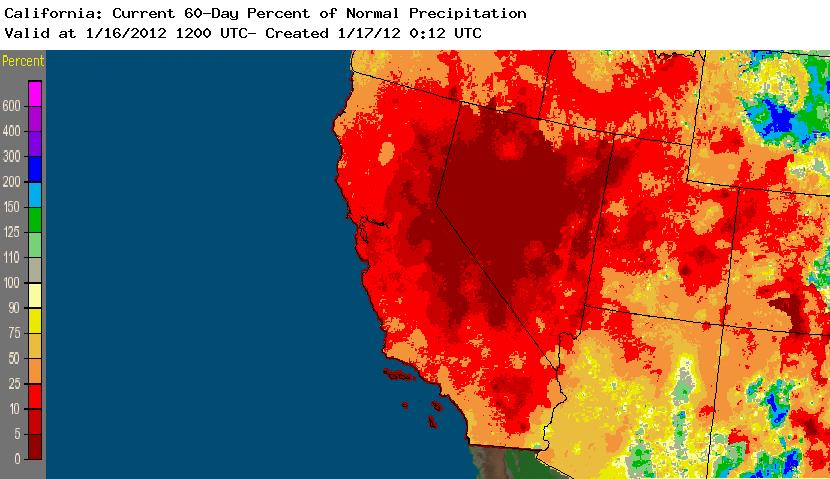
Well, it does certainly appear that the remarkably quiescent and dry weather pattern that has persisted nearly throughout California since November is finally coming to an end. After more than two months of extremely dry conditions during what is normally the height of the rainy season, nearly the entire state has accumulated some truly impressive precipitation deficits. Most of Northern California is experiencing hyrdological drought according to NOAA’s Palmer Drought Severity Index, with a good portion of the Sierra Nevada squarely in the “severe drought” category. Fortunately, though, these metrics are based primarily on short to medium-term soil moisture, which (as those who have lived in this state for more that a few years already know) can change quite quickly under the right circumstances. And it starting to appear that conditions may be right for some very significant precipitation over the next 10 days.
First things first, though: a very cold Arctic airmass has invaded the Pacific Coast of North America over the past few days, bringing snow all the way down to sea level in Washington, Oregon, and even briefly on the beaches of the far north coast of California. The entire state of Washington, and much of Oregon, are expected to receive heavy and possibly record-setting lowland snowfall over the next 3-4 days, with accumulations exceeding 12 inches possible all the way down to sea level near Seattle. While California is unlikely to see any extraordinarily low snow levels this week (outside of the possibility of a few more flurries along the far North Coast early Tuesday morning), a long-duration (and possibly record-setting) deep freeze is already underway across much of NorCal this evening. Temperatures by 11 PM had already dropped into the 22-27 degree range across large parts of the Sacramento Valley and were already below freezing across much of the Bay Area. With dewpoints mostly in the low 10s, record low temperatures are likely across large portions of NorCal on Tuesday as surface temperatures drop into the low to mid 20s in most locations and even as low as 12-17 degrees in the coldest valleys, even near sea level. In short, tomorrow morning will be very cold by NorCal standards, and there will probably be some agricultural damage and perhaps even some burst pipes as a result.
These cold temperature, though, will not last long. By Wednesday, warm and very moist air will initially override and eventually displace the cold and dry Arctic airmass over California as a strong zonal jet–yes, finally, a strong zonal jet!–noses into the far northern part of the state. Rain will begin slowly over far NorCal on Wednesday and spread southward through Thursday, reaching the Monterey Bay Area by late in the day. PWs over 1.5 inches are associated with these incoming systems, and there will be a moderate low-level jet acting to squeeze out some fairly high precipitation rates over the Coast Ranges and the Sierra Nevada. This sort of precipitation will be highly beneficial, since rain rates will not be high enough to cause any flooding problems but accumulations will be rather significant, perhaps on the order of 2-4 inches in the higher elevations, with 1-2 inches elsewhere. A similar storm is expected to arrive by Friday and drop a similar amount of precipitation across NorCal. The first storm probably won’t make too much headway into Southern California, perhaps bringing some light rain, but the second system will probably bring at least some precip to the entire state.
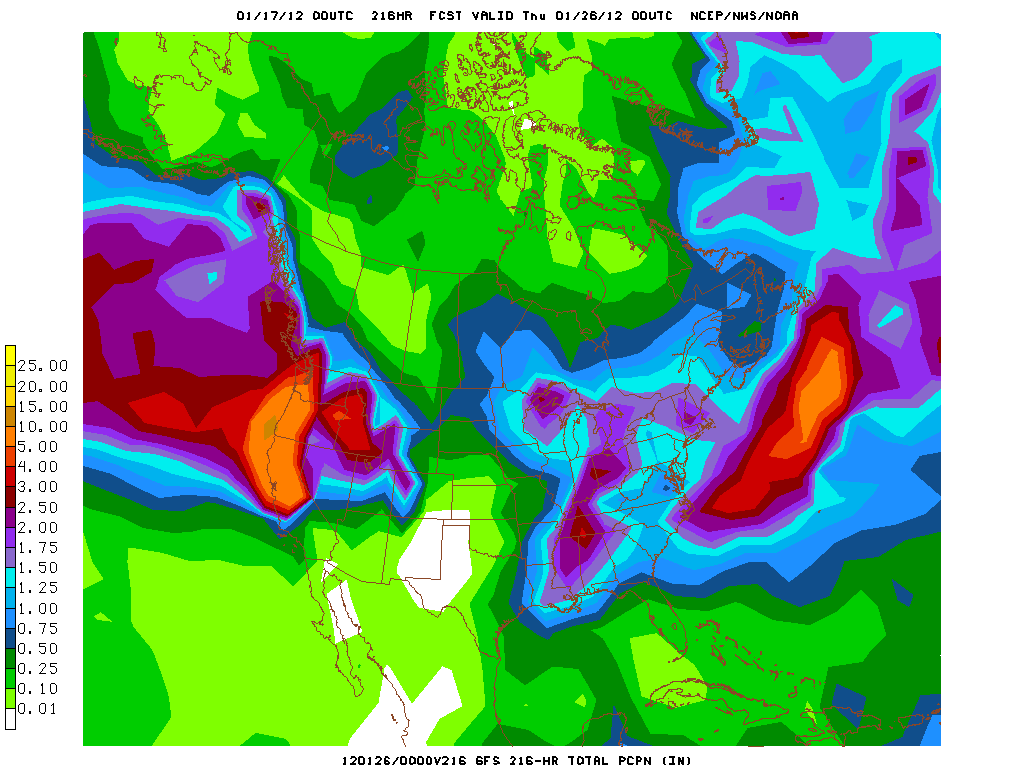
Probably of greater interest is the possible evolution of the pattern days 7-10. The extended forecast models–and the GFS in particular–are showing early indications of what could be a very significant precipitation event on Day 8. It appears that a large and deep cyclone off of the Washington and B.C. coasts may set up a long and deep band of subtropical moisture convergence somewhere along the Pacific Coast. With the presence of a very strong zonal jet (and also a low-level jet enhancement near the coast), this is a setup that has the potential to produce heavy precipitation where the moisture plume hits the coast. The 00z GFS focuses this plume on Central California, bringing very heavy 48-hour precip totals to the Bay Area next Tuesday. This is still over a week out, and very much subject to change, but it ‘s worth keeping an eye on considering the soil-saturating rains expected over the next 7 days over the northern 2/3 of the state.
In any case, one statement can be made with very high certainty: winter is, at last, on our doorstep. Stay tuned.
© 2011 WEATHER WEST


Currently raining on top of the snow from yesterday, bummer! Snow level to climb to 7000′. My sons ski trip for tomorrow was canceled due to predicted rain on Mount Shasta. Looks like we start to back into a warming and drying trend by Thursday. Sounds like if we do not get much more precip especially for the central and southern half of the state fire season could be upon us early this spring. Ken what’s your thoughts?
Coldspot, It is starting to look like this winter will end being dry this year, it appears we are headed back into a dry period, with the next rain some time toward the middle of Feb. I hope I am wrong. We are expecting a pretty good Offshore event tonight into tomorrow, highs in the low 80′s, with another moderate event this weekend. Like Dan has said in the past, our drier years end up producing warm to hot springs, which equals an early start to fire season. Our rain yesterday was better than I thought we would get. Picked up .41 at the house (Granite Hills) yesterday.
Thanks for your thoughts Ken. I think we have both been around long enough to have a decent feel for what. The fiire season might hold. However, I have been wrong, usually.
It is not necessarily drier than normal years overall that lead to hot spells in spring, rather, it seems to be years in which the rainy season comes to an end earlier than normal, such as 2004 and 2008, in which most of March and April are much drier than average. Much of the time, however, those years are somewhat drier than average as far as total rainfall goes. 2001-2002 and 2006-2007, two of our driest years on record, if I remember correctly, led to a fairly normal spring season temperature-wise in April and May, although the fire danger was much higher than normal due to the dryness of the winter.
Dan, that would make a lot of sense due to the fact that in drier years the live fuel moisture levels are lower. Once most live fuels ( brush types) get below 80percent fuel moisture they are readily avalible to burn and will contribute to fire spread.
Continuing, that is why with dry winters like this one we might expect a earlier start to the fire season with larger fires probable.
Well, there are also less of the invasive weeds that spread fires during dry years. The. Bottomline is that there’s always high fire danger except during and after wet period. More dependent on numberand severityof Santa Anas than anything.
I think some people are throwing in the towel already this year for a decent season. Just like in sports when you have a bad season you just got to brush it off and start with a clean slate next year. Its just that off season is a bit rough.
I’m pretty much resigned to the fact that we’ll have a below average year this year. We would have to get 15 more inches by July in order to break even. It’s possible but definitely not likely. At this point, I’m just hoping we’ll get at least a couple big storms before the rain year ends. We can get big storms through April, so there’s definitely some time left for that.
I am actually in LA for a short visit and looks like the weather will be boring the whole time. Oh well, I will enjoy the sun visiting from VT and I am not missing any good snow right now.
Santa Ana’s do very little to the areas I’ll be in so even that will be a non event. More fun than freezing rain I guess.
Its so bad that most of the time in Late fall-Early Spring I would check the models 4 times a day. This year I have only been looking at them a few times a week.
What I would like to know is when we are ever going to get out of fall and go into winter? This warm and dry pattern with a series of Santa Ana wind events is more like November and December. Something is going to give at some point this winter and we will finally get into a rainy pattern for at least a while, even if rainfall totals for the season are likely to be below average. We can’t possibly go from this weather right into spring with the marine layer and onshore pattern without some storminess in between.
I see much of Socal is under a Red Flag Warning. How unusual is that for Socal in January? This month we had a Red Flag Warning around Tahoe, which is the first time I can ever remember that happening in January in my lifetime. It just speaks to how unusual this winter has been.
It happens from time to time if the fall and early winter have been dry, but it is more unusual for the end of January, as it usually turns wetter or there are fewer Santa Ana winds at this point in the season. Tahoe usually has had more rain or snow by now, so Red Flag Warnings I would think would be incredibly rare for that region this time of year like you stated.
The Santa Ana winds are blowing quite strongly here tonight in Orange, definitely one of the stronger events for this time of night of the season so far. The really strong winds have a tendency to come up in the very late night or early morning hours as opposed to the evening in most cases.
Last night winds were fairly calm — had a slight breeze — was bout 60 at bout 9pm last night 1-27-12 — but dipped down to 39 at my station in Redlands, Ca – 1-28-12 – although Cal State San Berdo by Cajon Pass only got down to 60 because of the winds — they even closed the campus 1-27-12 —- they never closed the campus when i attended — i had a hand-held wind speed/direction that measured 65 mph — thats windy at Cal State San Berdo —
Wow anyone see the 18z? Looks like a monsoonal event on the run. I have read that in very rare times the monsoon can kick up in late April/Early May but never February.
Yeah, it seems like the seasons are all mixed up now. At this point, I’m expecting major rains in May and June.
Despite most forecasts indicating that this dry weather is going to continue for the foreseeable future, I really think a change in this pattern is going to happen somewhere around the second week of February. Even in most of the drier years, a pattern change occurs sometime during the winter that leads to increased rainfall for at least a little while. A good example of this occurred in a season in many ways similar to this year – 1999-2000, in which the fall was extremely dry, followed by a fairly dry January, only to turn much wetter from February to early March and one significant storm in April. This season has only seen two storms in Socal since the middle of December and umpteen Santa Ana wind events and it would seem right if February turns out to be wetter than January.
I was just reading an article on Accuweather.com regarding the extreme cold in Fairbanks, Alaska. Here is a short excerpt from the article:
Today marked the second consecutive day of temperatures to or under 50 below zero, the first such occurrence since the last two days of December 1999. Before Saturday, Jan. 27, 2006, was the last time temperatures dropped to 50 below zero in Fairbanks.
Saturday’s high in Fairbanks was held to 42 below zero, the coldest high temperature at the airport since Jan. 2, 2000. A similar high is expected today before temperatures slightly recover Monday into Tuesday as a storm system delivers a bit of snow to eastern Alaska.
Temperatures in Fairbanks have been 40 below zero or colder 15 days so far this month. That ties the record from 1972 for the most 40 below zero January days in the last 40 years.
What is interesting here is that two of these records for cold were set in the 1999-2000 season, bolstering my idea of that year being a good analog to this year. Additionally, 1999-2000 was incredibly mild from coast to coast much like this year has been, meaning that the cold air was trapped up in Alaska during both seasons.
However, what is somewhat concerning here is that this January ties January, 1972 for the most -40 days in Fairbanks because 1971-1972 was just plain awful for Socal with Los Angeles receiving approximately a whopping .25″ of total rainfall from January to April, normally our wettest time of the year! Hopefully this year doesn’t follow 1972, although this January has already been wetter than that.
I made a mistake here, there weren’t any records of cold set, rather, they were just occurrences, but that doesn’t change my idea if 1999-2000 being an analog, though.
Received about a tenth of an inch of rain in about twenty minutes tonight, then it was all over. Been burning slash piles around Mount Shasta on Friday, and when you scraped the sparse snow and pine needles away the soil and duff were dry. Very unusual for this time of year.
I can’t believe how incredibly dry Norcal has been this year. Socal, on the other hand, experiences dry weather more frequently due to latitude. One of the reasons I think a major pattern change is coming soon is that this level of dryness cannot persist in Norcal all winter long, especially with such a dry fall and due in part to the higher latitude being nearer to the main storm track. San Jose has had less than 2.5″ rain this whole season to date and that would be dry for Los Angeles and even San Diego! I believe it would be almost unprecedented if that did happen, but maybe it has happened sometime in history.
I agree that it feels like there ought to be rain on the way at some point soon, and that it feels like the longer we go without rain, the more we are “due” for an event. But does this match scientific reality? Given the current weather patterns here and elsewhere, does the *probability* of a pattern change really increase the longer things have been dry like this? Not knowing a whole lot about how macro-scale weather systems work in general (aside from the excellent stuff you and others here have written), I find it difficult to believe that the actual probability of a pattern change increases the longer we go without one. Do we have a scientific reason for thinking that the patterns must change soon? (Just to be clear, Dan, I’m not knocking you — I feel the same way, that there must be a change soon… but the scientific part of my brain is rebelling against this gut-level instinct.)
oops, just read your post a little further down where you address this. Sorry!
i read this in todays weather discussion — what does this mean —– says theres a major change coming on – however the next paragraph basically says theres nothing changing. It appears to me that everything is staying the same — boring weather with no rain or snow —- read below thoughts
BY WED…A MAJOR PATTERN CHANGE WILL BE
UNDERWAY AS STRONG CYCLOGENESIS COMMENCES OVER THE GULF OF ALASKA
AND DRIVES A SHARP RIDGE TO BUILD NORTH INTO WESTERN CANADA. ALL
MODELS INDICATE THE PATTERN WILL EVOLVE INTO A REX BLOCK OF SORTS
OVER NORTH AMERICA THROUGH EARLY NEXT WEEK.
UNFORTUNATELY…THERE APPEARS TO BE NO RAIN IN SIGHT THROUGH THE
FIRST TEN DAYS OF FEBRUARY. THE DRY AND BREEZY CONDITIONS WILL
LIKELY RAISE WILDLAND FIRE CONCERNS AGAIN LATER IN THE WEEK.
I just wanted to post a little thank you for this Weather Blog. My husband is a fire captain in So. California and this sure helps me keep updated with the forecasts. If this weather keeps up I sure fear it will be a busy wildland season once again.
Thanks again!
Well the pattern change is a Rex Block, No rain in site and it continues the very dry weather with a return to warmer Temps. after Wednesday. This high pressure pattern is sure locked in. And it does not look good for points north in Calif. either. Time to turn back on the sprinklers. Another wind event for Thursday to Saturday. Looks like the Red Flags will again have to be hoisted, if this wind comes through.
I just don’t buy the idea that it is going to stay dry like this for much longer despite what is being said.
The reason I’m saying this is because the ridge is forecast to build into western Canada and I have been reading about the possibility of a MJO wave propagating across the Pacific in early February. Oftentimes when that happens, the ridge gets undercut and the storm track comes in south under the ridge, especially during El Nino and in other times when the MJO activity is favorable.
Well…NorCal did get a couple of days of decent rain in mid-January, but that’s it. We’re back in an extremely persistent dry pattern–and, indeed, much of the US looks to be unusually quiescent for the foreseeable future. To-date precip percent of normal values briefly made it up into the 20-30% range in some parts of Norcal last week, but these are already falling back as the peak of the rainy season continues to pass without significant precipitation. For now, there’s no indication of a change to a more active or wetter pattern.
Whats annoying me the most is that this winter hasn’t even been that cold unlike 06-07. This is just getting sick.
That’s the toughest part. Basically nothing interesting has been going on in any way, whether that be precip or temps. I know you guys down there have had a couple wind events; we’ve had a little morning fog. That’s about it. This has also been the most uneventful winter I can remember across the country in terms of winter weather. The only big news has been in Alaska with the cold and snow.
We actually got a little bit of rain this morning. Mostly just enough to get the roads wet. It looks like there’s a good chance we could see a storm about a week from now so I’m hoping we’ll get into a wetter trend soon.
The latest forecast from San Diego WFO has a slight chance of showers for Socal for next Tuesday. I hope this may be the beginning of a pattern change towards a wetter pattern for CA for the second half of winter, and any wet period will be better than what we have been experiencing for the last 1 1/2 months except for the 2-3 storms that affected CA mid-January.
I have read on another weather blog that the Polar vortex that has been stuck north of Alaska on the Asian side of the Arctic and whereabouts for the last couple of months is finally showing signs of breaking down and changing. This has helped to maintain the almost constant positive AO pattern for the last few months and has been at least partially responsible for the exceptionally mild weather coast to coast in the continental U.S., and I believe that this is one of the main factors that has kept the jet from amplifying, thus leaving CA and other nearby states high and dry so far this late fall and winter.
Looking like we could get another outside slider system like what we had in early December.
We received 0.3 of rain the night before but overall still dismal. Slight chance by next Tuesday of another light precip event but I’m not holding my breath. All the snow around the house is now gone.
I can recall 2 Febuarys where we only got 1 storm system for the month. One being in the late 1990′s and the other being in the early 2000′s. I would look up the data but my internet is acting up and has been rather slow. Took me a long time just to get to this page.
Looks like we might get a little light rain next Tuesday from a weak cutoff system, but prospects for a long-term pattern change remain dismal. The persistence of this non-winter is truly remarkable.
Have you ever seen it drier in Norcal up to this point than it has been this year? While it has been very dry in Socal since mid-December, it hasn’t been as dry as it was in 2006-07.
This is definitely the driest year to date I’ve ever experienced in the Bay Area. This could still change, of course, by the end of the season if there is a dramatic pattern change at some point in the next 2 months. But I don’t foresee any precip chances except for the possibility of sporadic cutoff lows until at least the middle of February, and even these are likely to be pretty minimal precip producers without much cold air associated with them.
To get meaningful, significant precipitation in Northern and Central California at this point, one of two things needs to happen: either the Westerlies break through the ridge and bring periodic strong, moist systems in from the Central Pacific, or the blocking ridge retrogresses sufficiently for a mean trough to develop close to the West Coast, bringing frequent cold and moderately moist systems in from the Gulf of Alaska. Right now…either of these situations seem to be distant fantasies at best. It takes time for either of these patterns to become established and time for them to deliver actual precipitation. Pretty soon, we’re going to start running out of time for that to happen this winter season. As some have mentioned, we DO still have a couple of months where this could actually occur, and it is indeed possible that we get some much-need late season rainfall (a March Miracle, redux), so we’ll just have to see. In the meantime, we’ll continue to bask in the continued warm and dry weather with the very occasional chance of showers…/
For what it’s worth, AccuWeather’s long range outlook has us “mainly dry” through mid-March. I find it really hard to believe that this level of dryness is going to continue through March, despite the pattern as of late, unless we are repeating a pattern similar to 2001-02 or 2006-07. (I believe Norcal was wetter in these two seasons, though). I still expect some sort of a wet period sometime in the near future, more like a 1999-2000 or to a lesser extent 1998-99, unless this is an extremely unusual weather pattern setup this year that is shutting CA off from any prospects of rain like 1971-72.
probably not much. They also predicted a very snowy year for the Northeast. Granted, I did too, but… we were wrong.
Most models are indicating a lot of cut off lows once again through mid February… what’s odd is that’s how this winter started, with a lot of cut offs. Maybe winter will be getting a jump start this month? Guess We’ll have to see…
This is a post from the SCGCC Fire WX. Looking like it is going to stay dry.For Southern and Central California
SEASONAL OUTLOOK
Issued: February 1st, 2012
Valid for: March 2012 – May 2012
Weather Discussion
The long-running La Niña weather pattern which has gripped the Eastern Pacific is expected to continue through the late winter into the spring of 2012. The current negative sea surface temperature anomaly has been in place since late last summer and has likely peaked in intensity. Although the strength of the La Niña may be diminishing, it is expected to continue to be the primary factor affecting the weather pattern the rest of the winter into the spring months. Most long range computer models indicate sea surface temperatures will return to near normal sometime over the summer (Figure 1).
The expected drop in winter season precipitation which usually occurs during a winter La Niña appears to have commenced earlier than usual this year. Some of this can be attributed to the La Niña pattern, but a strongly positive Arctic Oscillation (AO) may also bear some of the blame. During the month of December, a very strong AO and North Atlantic Oscillation (NAO) was noted which tends to lead to warmer than average winters across most of the Continental U.S. This tends to keep most of the cold, arctic air suppressed in Canada and Alaska while strong westerly flow keeps the storm track to our north. This stands in strong contrast to the winter of ’09-’10 which produced a strongly negative AO and NAO and a cold and wet winter for much of the Continenal U.S.
Typically, precipitation tends to be slightly above normal during the fall onset of a La Niña before tailing off by the first of the year. This occurred earlier this season when a series of weak systems brought some wetting rains to the area in October and November. But as the season progressed, precipitation decreased as a strong ridge of high pressure developed offshore. And, at the time of this writing, nearly every observation station over Southern California is reporting below normal to far below normal seasonal precipitation (Figure 2).
It is unlikely Southern California will catch up to average precipitation given the circulation patterns in place over the Pacific and below normal precipitation will continue the rest of the winter and into the spring months. Most “Rainy Season” precipitation usually decreases markedly after March 31st, and this year, little meaningful precipitation can be expected in April or May.
Sounds like we could be in store for a big time late winter heatwave if the models are right.
Forecast for Whittier CA. Wunderground.
Thursday 2/9/2012 Clear. High of 90°F. Unseasonably hot. Winds from the ENE at 5-15 mph shifting to the NNW in the afternoon.
A storm system is forecast to be near the area around Tuesday or Wednesday, and whether or not it brings any rain is not yet known because it is a cutoff low. By Thursday, the storm may or may not be out of the area, and even if it were sunny and warmer by then with a bit of an offshore flow, I certainly don’t think it would be remotely close to 90, probably more like in the 70s.
It seems that every time the pattern tries to change this season to a stormier one here in CA (from mid December onward, but probably has been going on longer in Norcal), it is only a quick change with a relatively weak storm or two, and the ridge seems to just bounce back very quickly as something is relentlessly reinforcing this pattern much more than a typical year, even a typical La Nina year at that. Does anybody have any idea what is constantly reinforcing this ridge? Is it that the MJO has been stuck in the western Pacific or the Indian Ocean, or is it just simply a persistent +PNA, or is it a combination of factors with the recent spike in solar activity? The AO finally went negative mid-January, but that didn’t seem to change the pattern locally and I believe a +AO is one of the key factors that aids in drier than normal weather here.
The reason I am wondering is because even in drier winters, we often get a wetter period at some point in the season even if part of the season is abnormally dry. It is rare to go through the entire late fall and winter as dry as it has been this year, unless we are in a pattern like 2001-02 and 2006-07, but Norcal was much wetter in those years despite the dryness in Socal. Of course there is always a chance for a wetter period later this month into early April.
Looks like are one day of winter is on tap for this season. After that Spring comes.
12z Nam shows nice cape with this storm…maybe we could get some severe thunderstorms fired up…
then again, thats the only model that has excellent connective parameters.
Looks like this storm will be a good coastal thunderstorm producer from Eureka south.
http://apps.startribune.com/blogs/user_images/pauldouglas_1328049452_denial_4.jpg This best explains Winter so far.
Looks like the only storm of February is going to be a flop. That is kind of fitting for the way the season has gone.
The models continue to build a monster ridge.
It brings a tear to my eye, seeing all that activity offshore….
a few sprinkles here and there, ground got wet in rancho cucamonga… for a minute…. back home tonight i don’t expect any snow, 41 right now, bleh…….
we’ll get winter for a week or two in march (meaning one or two storms fairly close together) and that’ll be that!
Well at least it is snowing @ snow valley, another 800 feet above me
It has only sprinkled a bit here in Orange so far. I am eagerly awaiting the rain from this storm such as it is. I do see a band on radar directly south of the area moving north and I hope it gets here soon!
We got about a “Trace” of rain here in Whittier. It’s the classic patter of once one things goes wrong in the season it sets a trend and that continues through the year. I remember in the 04-05 megaseason we only had 2 flop storms and that was late in the season.
The 2004-5 rain season was a good year in Redlands, Ca — i got 24.21 of rain for the year —-Oct we got 6.07 – January we got 5.82 — Febr we got 6.39 — those were the top months
Seems like the north part of the state got about the same as you did in Whittier, Nicholas. Enough to wet the ground in spots and get a few drips off the roof then it was over. Was burning hand piles for the USFS with our conservation crew around 4500 feet yesterday the piles crept all over the place . On the south facing slopes we managed burning out some of the green brush component. It’s very dry out there.
What a flop storm — Redlands, Ca has not received nothing 0.00 — looks like February will go rainless —- Any storms in the near future — I noticed that the humidity at 8am was like 52% but around 10-11am was 28% — too dry for it to rain — right now at 921pm humidity is 62%
Looks like starting Sunday some storms will drop from the GOA… colder storms.
I really hope that pans out. Actually, I wouldn’t be surprised to see a breakout pattern change start to develop over the next several days in the models. Right now, the trend’s our friend.
Looks like we faired a little better here in SD county, Picked up .20 before the East-NE wind came up drying things out, had winds for several hours 15 -20 MPH at the house(Granite Hills) Nice to see it rain, but it really does help overall in this dry pattern.
Coldspot you need to get some rain, if not looks like we will be up north this summer if there is a lighting bust.
Ken, your exactly right but they are hinting at a change in the pattern by the start of next week. However due to a dismal snowpack it would have to be a substantial length and intensity of events to recover before the fire season. As you know we could have a cool summer and since our starts up here are 75 percent lightning caused it could still be a ” normal” season. As ” seasoned veteran FF”, that you and I are, we know when people ask what kind of fire season will it be? We reply tell ya in November. Ha ha
You are right, can never predict the fire season. I hope the pattern change does come. We could use some moisture, especially mountain snow.
The trend’s you freind, when your IN the trend.
Having a rough crossing this time, passed our eastbound counterpart yesterday morning on the Date Line they asked about the weather, we told them situation normal. Disappointingly dry.
Long range does look interesting, for once, as mentioned starting early next week and storms getting progressively stronger, more or less, feb 24 looks interesting. A cutoff low west of point conception gets absorbed by a cold front coming down the coast and kind of blows up over socal.
It did snow less than 1/2″ between 5pm and 9pm last night….
This storm was also a flop here in Orange, where I received a whopping trace, not even enough to get the ground completely wet. It only sprinkled off and on from the afternoon to early evening and that was it.
We are overdue for a pattern change toward a more-prolonged period of wetter weather. This tends to happen in many winters, although there are exceptions to the rule like 2001-2002 and 2006-2007, but those are certainly exceptions.
PG&E meteorologists predict another Miracle March, wet pattern late February through early April: http://tinyurl.com/78eekol
PG&E’s meteorology office in San Francisco is predicting a weakening of this winter’s stubborn La Nina pattern that has helped shunt storms north and kept them from entering much of the state including central California.
John Lindsey, PG&E forecaster from San Luis Obispo says a weakening of La Nina will allow the polar jet stream to drop south and set up a wet pattern when the storm door should be open from late February through early April.
“This ought to provide relief to much of California” suffering this year’s record dry conditions. “It is a similar pattern to what happened in March 1991,” the so-called March Miracle that helped saved the state after several years of drought. ”I’m not predicting that – but the pattern is the same.”says Lindsey. Like this water year the 1990-91 season was one of driest winters on record at least until a wet March boosted ski resorts, filled reservoirs and saved all water users from catastrophic shortages.”
How many of you remember the 1991 Miracle March? I remember it well even though I was pretty young at the time. Keep in mind that back then we had been in a drought for 5 years with low reservoir levels so the overall situation was more dire than it is today. We still need a great March though.
I remember the March Miracle in 1991, which featured a very dry winter like this year has been so far and then it turned very stormy in March with good rain and mountain snowfall. I think this fall was wetter than the fall of 1990. Much of CA including Socal was going through a very dry period in the late 80s and early 90s and this period of wet weather was a turning point that led to many wetter years afterward which lasted until 1998.
Late wet spells following long dry periods such as the March Miracle of 1991 is one of the main reasons I am always saying that a wet pattern has to come at some point following a particularly dry winter period like we have been experiencing. I know there are exceptions to the rule in the driest of years like 1961, 2002 and 2007, in which small storms bring occasional rain throughout the season but with long dry periods in between. This year has behaved like that to some extent, especially from mid-December to the present, but none of these driest years on record have been in a La Nina, though.
I’m not really sure where that prediction is coming from–there really isn’t a strong signal for the rest of the season. While it’s true that La Nina is slowly weakening, it’s not at all clear to me what effect that might have this late in the season (and for NorCal, La Nina’s effects are hardly clear cut, anyway, unless it’s a really strong event). So while it’s certainly possible we’ll have a Miracle March redux, I have no reason to believe it’s any more likely this year than in any other. There does appear to be the potential for a more unsettled regime for the next week over CA, which is good news, though I still doubt we’ll see a whole lot of precipitation. And I certainly don’t see any big storms or major precip producers on the horizon. We’ll see. I’ll try to have an update soon for the modest pattern change on track for next week…
2nd time a real cold storm is showing up, long range GFS (348hrs and on), i haven’t seen a storm that cold come to fruition in socal in the few years i’ve been watching these models, not a ton of moisture, but damn that’s gotta produce frigid temps, especially behind the front…
well don’t look now, it’s gone again lol. Hey nothing better to do without a real winter anywhere in site…
Looks like a parade of inside sliders/weak storms/outside sliders. Nothing that looks to put much rain in the bucket for So Cal.
I’m gonna put myself out there and say that one of them will be turn in to a whopper, specifically the last one (wednesday). A deep cold core, meander a little too far east, pull in a ton of pacific moisture, and finally veer west after rounding point conception and slam into socal!
I am sure one of these things will pull a surprise. One analog I wish I could find is the day of the setup of the Compton thunderstorm in November.
This has been the case for the past year…
I am sure the power of the all seeing eye can bring some moisture to this area.
Am predicting in my area — Redlands, Ca — the next 5 days — tops 0.20 of rain — but having a feeling its gonna turn into another few more flop storms
The power of the all seeing eye might also bring the next storm systems with the coldest track.