Cutoff low to bring thunderstorms, extreme fire weather to much of California

After what has thus far been a remarkably quiet summer in California, a significant and potentially very noticeable pattern change is currently underway. A Rex Block has developed over the far Eastern Pacific and the West Coast over the past day or so, forced (at least in part) by blocking induced by the remnants of Tropical Storm Lee current wreaking havoc in the Eastern states. The upper-level low currently located over northern Nevada will retrograde very slowly over Northern California over the next 24 hours and eventually set up shop off of the Central California coast this weekend, staying nearly stationary until at least early next week. As the low begins to move offshore, counterclockwise circulation will induce southeast and easterly flow over the northern 2/3 of the state, advecting monsoonal moisture into Northern and Central California from the Desert Southwest. Most of this moisture will be at mid and upper-levels, and any convection that develops on Friday or early Saturday will likely contain little or no rain, leading to a potentially widespread threat of dry lightning. By later in the weekend and possibly continuing into early next week, this flow will probably contain enough moisture to result in wetting rains in most thunderstorms as lofted moisture from diurnal storms serves to moisten the lower levels with time.
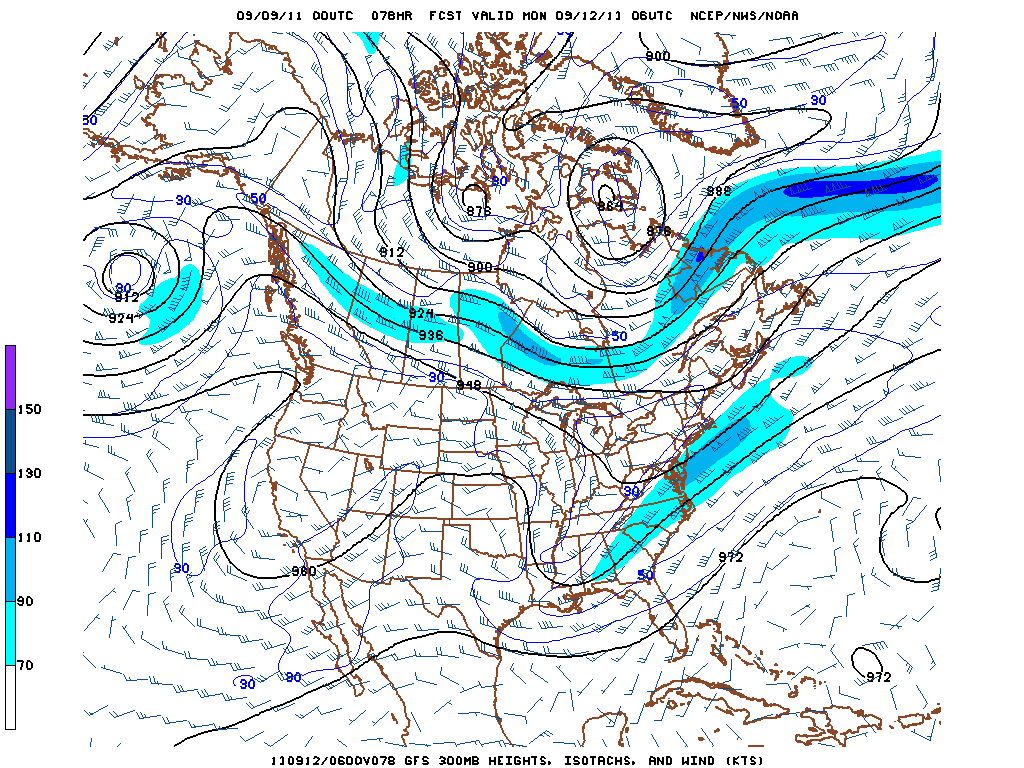
GFS forecast of retrogressive upper-level low on Friday

Not only will there be the threat of dry lightning this weekend, but easterly flow will result in downsloping, offshore winds in the Sierra foothills, Central Valley, and possibly the Bay Area. The triple threat of hot, potentially gusty offshore winds, low surface humidity, and possible dry lightning will probably cause some fire-related problems this weekend. This system also has the potential to bring multiple rounds of lightning to unusual areas, including the Central Valley and the Bay Area. Much of Southern California may miss out on the deep convective activity as it will remain in a pronounced dry slot for much of the event, though some potential for dynamically-forced elevated convection does exist over almost the entire state at some point during the next 5 days.

The numerical models are currently in disagreement regarding the evolution of the pattern after next Monday. It does not appear that this cutoff will be in any hurry to leave, however, and the risk of at least mountain thunderstorms (and possibly elsewhere) may continue straight through the next week. Stay tuned!

© 2011 WEATHER WEST

89 thoughts on “Cutoff low to bring thunderstorms, extreme fire weather to much of California

  1. I’ve become more interested in the cold front mid/end next week, socal may even get decent rain,

    This weekends monsoon event for socal is looking more and more typical and unimpressive….

  2. well since there hasn’t been anything to look at in months, i hope that monster on the 10/11 decides to push further south, looks like a soaker for norcal at least…

  3. Getting a bit late for monsoons, isn’t it? Time to look for cutoff lows and errant early-season fronts like the one I just saw on the GFS. .1-.25 like it was forecasting (not counting orographics) would be significant for early October for sure, and a good sign for the rainy season as wet octobers tend to be correlated with wet years in general. Unfortunately, though I ultimately think it will be a drier than average year in So-cal as the La Nina setup looks similar to last year… last year happened to get one series of very intense storms but it seems unlikely to get two la ninas like that in a row… though who can say for sure? The lack of ice in the Arctic certainly bumps the jet streams around a bit.

    Either way I anticipate another quite snowy year in Vermont, between the La Nina and the fact that we’ve been in a very wet pattern for the past several years, really. With la Nina there will be enough cold for plenty of Dec-Mar snow, and with this weather pattern, plenty of moisture too.

    • You kind of have a point. If we did not count those storms in the December we would have had 80%-90% of normal rainfall for Los Angeles. Needless to say, getting 40% of the season’s rainfall in a few days is a very rare event indeed.

      • Though, It is hard to believe that Southern California will get below average rainfall this year. There is so much activity in atmosphere. If anything, Southern California should get out this winter with at least average.

      • At my station – in Redlands, Ca – Southern California — the 2010-2011 turned out to be above normal — but we received 10.46 of rain for December – which was 54% of the grand total of 19.31 — without the 7 days it took to get 8 of the 10 inches — Redlands would of had an below normal rainfall — Jan-June we got additional 7.04 of rain — basically went dry after December — could of ended up with a real record-breaking rain year — The 10.46 I recorded in December – was the wettest for the month — second greatest overall — most ive recorded for a month is 11.70 in January. —- December 2010 with 10.46 smashed my previous record of 5.50 set in Dec 1984

  4. I have to say, the ECMWF is much wetter with these two storms than the GFS. However, the latest 12z GFS got noticeably wetter for the second storm. is this model catching on the to ECMWF or is it just a outlier? We’ll see! haha

  5. I found this on the San Diego National Weather Service — This Day In History — found it to be interesting — – found other comments recently about getting rain/moisture from remants of dying hurricanes

    October 2 1858: A category one hurricane hit San Diego, the only documented hurricane to strike California in history. This occurred before official weather observations began. Implied winds of at least 75 mph were based on damage and journalistic accounts. Extensive wind damage to property neared F2 (Fujita Scale) damage. Streets were swept clean by heavy rains.

  6. I’ll try to have an update on the incoming pattern change later today or tomorrow.

    Re: San Diego hurricane: that is a pretty fascinating historical fact (which was only recently rediscovered, as it turns out–most news and sailors’ accounts had been lost to history). I think the take-away lesson from that is that the state is not, contrary to popular opinion, completely invulnerable to tropical cyclone strikes. It would require a very powerful tropical system, some pretty unusual (but not unheard of) steering flow, and perhaps some unusually warm coastal SSTs (like during a strong El Nino event, for instance), but it’s not inconceivable.

  7. If I remember correctly, tropical storm Nora made landfall as a tropical storm in Yuma, Arizona in September, 1997 (very strong El Nino) after travelling up the Gulf of California. It brought about a half an inch of rain here in Orange. Also, a tropical storm came ashore around Long Beach in September, 1939 (another El Nino year) and brought rather high rainfall totals to Socal.

  8. I remember nora. I remember being very angry having to be in school and missing out on the squall like likes that moved through my area. I recall 2-3 times that day where it rain/wind started and ended just as fast.

  9. Looking more likely that i could see an inch or so of snow @ the tale end of this on Thursday @ 6200′

    That’ll be the earliest i’ve seen snow in that area….

  10. Just a trace of rain here this morning so far. I am sure that the ground levels are quite dry and it takes a while to juice things up. We haven’t had any real measurable rain here in Whittier since the end of August during that one night of thunderstorms. Before that it was a freak drizzle storm in early July.

  11. That is one fast front. Its zipping through California. To be honest, that front looks weak and ordinary, but its still impressive for October.

Leave a Reply